Minimum Durability Date (MDD)
Last updated: September 7, 2026
What is the DDM?
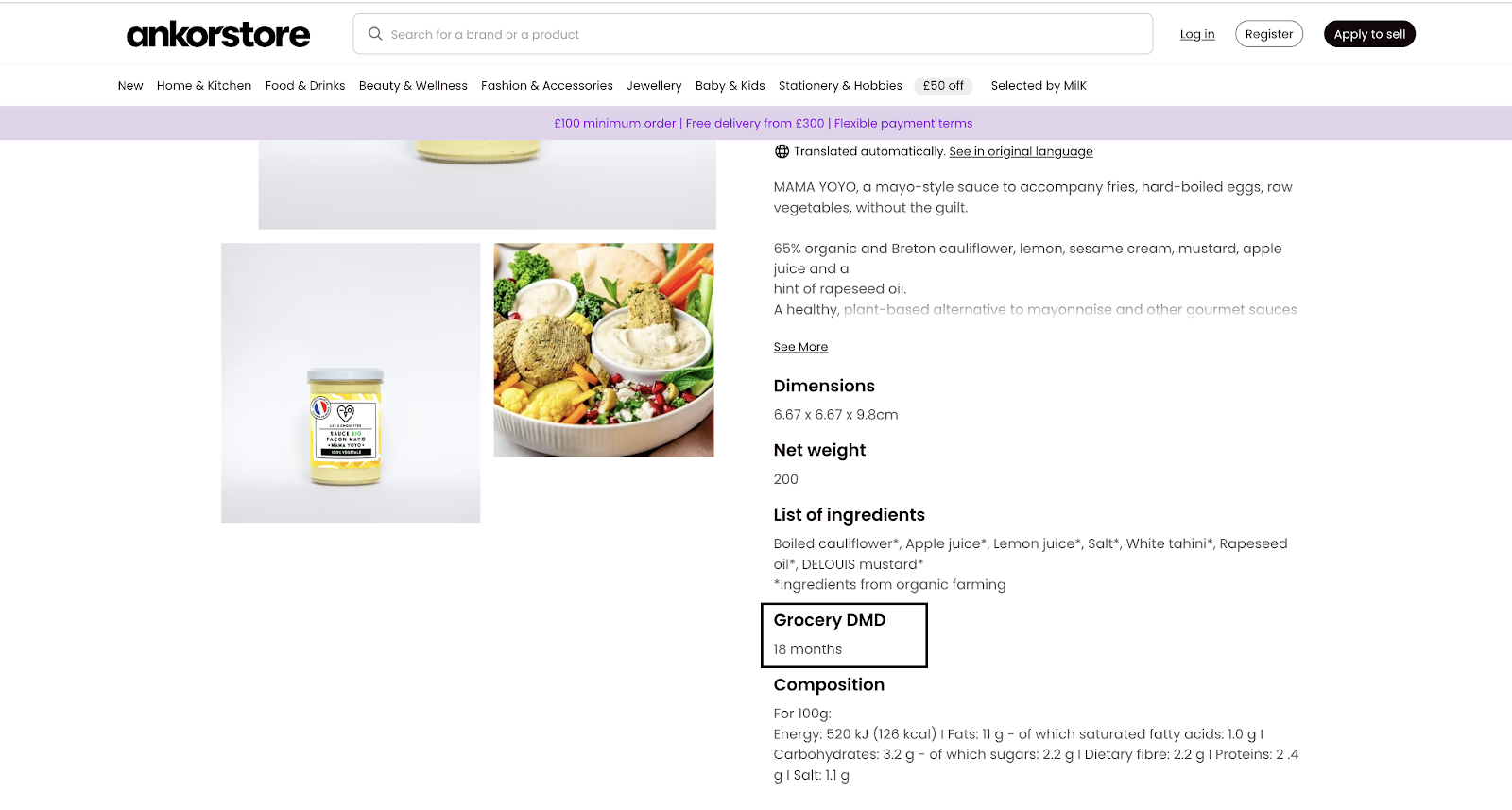
The Date of Minimum Durability (DDM, sometimes called BBE or Best Before End) is a fixed date indicating until when a product retains its specific qualities (taste, color, texture) under appropriate storage conditions. On Ankorstore, each product has a DDM expressed in months, which represents the duration between the production of the product and the moment it will reach its DDM. It is displayed as follows:
Day & Month for products with a DDM under 3 months
Month & Year for products with a DDM between 3 months & 18 months
Year for products with a DDM over 18 months
When is the DDM mandatory?
The DDM is mandatory for:
Food products (with some exceptions)
Cosmetic products
Certain other consumer goods whose quality/efficacy may deteriorate over time
What is the difference between the DDM and the USE BY DATE (expiration date)?
DDM (Date of Minimum Durability):
Also known as "Best Before".
Indicates the date up until when the product retains its specific qualities, such as taste, color, and texture, under proper storage conditions.
Commonly found on food products, cosmetics, and certain household items.
After the DDM, the product is generally still safe to consume, but it might not be at its optimal quality.
Use By Date:
Often called "use by" or "expiration date" (DLC in French for the French version only)
Indicates the date by which the product must be consumed or used for safety reasons.
Commonly found on perishable products, such as dairy, meat, and medicines.
After the use by date, the product may no longer be safe to consume or use and must be discarded.
New catalog fields for fresh products
To better manage perishable products and set clear expectations, two new fields are available in the catalog:
Storage temperature (0-4°C): This field indicates that the product needs to be stored between 0 to 4°C.
Guaranteed shelf life upon receipt: This field indicates the minimum remaining guaranteed shelf life for the retailer upon receiving their order, before the product reaches its use by date or DDM.
This information can be expressed in days, weeks, or months depending on the type of product.
These fields can be used for perishable fresh products. They allow:
Setting clear expectations for retailers
Replacing the default rule of 3 months of freshness with specific information defined by each brand
Improving inventory management and reducing waste
The product expiration rules are now based on what each brand defines and displays in the catalog.
Why is the DDM important for B2B transactions?
Ensures compliance with consumer protection regulations
Helps retailers effectively manage stocks
Maintains product quality throughout the supply chain
Protects the brand's reputation
Reduces waste and financial losses
Seller Responsibilities
As a seller, you must:
Ensure products display correct DDM information
Maintain appropriate storage conditions to preserve product quality
Remove products from sale that have passed their DDM
Provide accurate DDM information in product descriptions
Best Practices for Stock Management
Regular stock checks for upcoming DDM dates
Stock rotation according to the first-in, first-out (FIFO) principle
Monitoring appropriate storage conditions
Clear documentation of DDMs for all products
Ensuring sufficient shelf life upon shipment: by default, we request at least 3 months of remaining shelf life upon receipt by the retailer unless otherwise expressly stated on the product page
If you want to know more about the DDM, please refer to :